Amateur radio in Svalbard
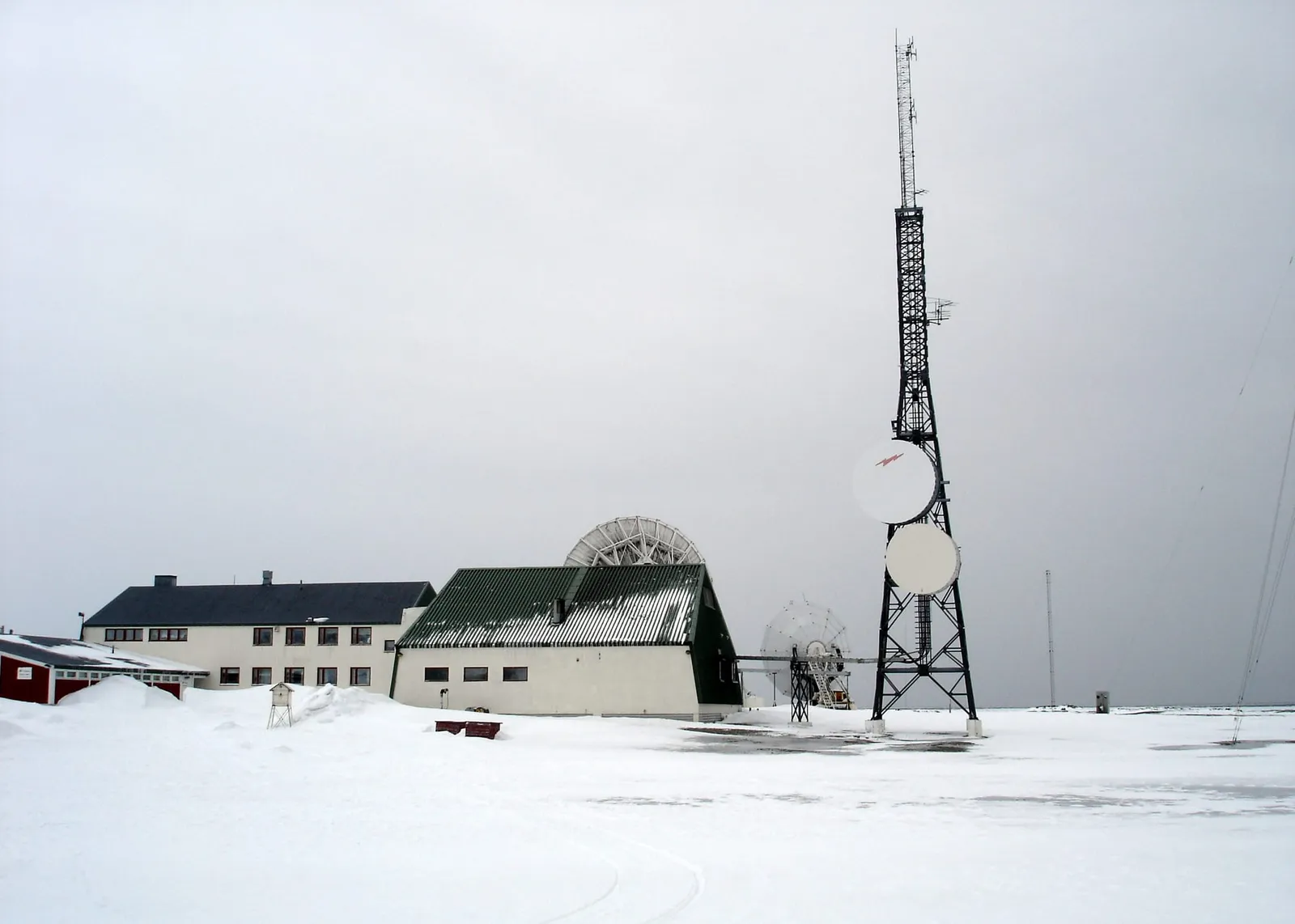
Photo: Mikeangelo, CC BY-SA 3.0

Svalbard is its own DXCC entity, with the prefix JW. There are scheduled flights, a club station you can rent in Longyearbyen, and more than a thousand SOTA summits. This guide covers the licence, the club station, the award programmes, and the local rules that matter when you operate this far north.
Licence and call sign
With a CEPT licence, you don’t need a separate licence for a visit. Under CEPT Recommendation T/R 61-01, Svalbard is listed separately from mainland Norway, with the prefix JW, and a CEPT licence is recognised there. In practice:
- Your call sign is your home call preceded by JW, for example JW/DL1ABC. Separate the prefix with “/” in telegraphy, or say “stroke” in telephony.
- It’s for visitors only. The CEPT licence covers temporary stays by non-residents, within the validity of your home licence. It doesn’t apply if you hold a temporary licence issued abroad.
- Bands: you may use all amateur bands that are authorised in Norway, and you must follow Norwegian rules and any local restrictions.
- Bring your licence. You must show it to the authorities on request.
- No interference protection. As a CEPT visitor you can’t claim protection against harmful interference.
Licensed outside CEPT? Several non-CEPT countries take part in T/R 61-01, including the USA (Amateur Extra and Advanced), Canada (Advanced qualifications), Australia, New Zealand, Israel and South Africa. If your country isn’t covered, check with Nkom, Norway’s communications authority, before you travel.
Holding a Norwegian licence with a call sign that doesn’t start with LA? Norway’s amateur radio regulation, in force since March 2026, says to put JW in front of it, for example JW/LB1XX. Bjørnøya (Bear Island) uses JW too; Jan Mayen is a separate entity with the prefix JX.
Rules to know before you transmit
- Follow the Norwegian band plan. The JW5E club station makes this a condition of use.
- Stay away from Ny-Ålesund. The research town is surrounded by a 20 km radio-silent zone. The amateur radio regulation doesn’t cover 2–32 GHz within 20 km of Ny-Ålesund, and Kings Bay, which runs the town, doesn’t allow wireless equipment there at all, including Wi-Fi and Bluetooth. Don’t plan to operate in the area unless you’ve cleared it with Kings Bay first.
- Equipment and customs. The CEPT licence has nothing to do with importing radio equipment; normal customs rules apply. Svalbard is a separate customs area, so check what applies on the way in and when you return to the mainland. See Getting there.
JW5E: the club station in Longyearbyen
JW5E belongs to Svalbard Amatørradioklubb (SARK), the Svalbard group of the Norwegian Radio Relay League (NRRL). The station is in Longyearbyen at Vei 401-15, locator JQ78tf, and visiting operators can rent it.
What you get:
- the station hut, with a lounge and kitchenette;
- a 26 m tower with a rotator, carrying a rotating 40 m dipole at 30 m and a JK Navassa (10/12/15/17/20 m) at 28 m;
- wire antennas for 160 m (double L), 80 m (inverted V), 60 m and 30 m (sloping dipoles);
- an antenna switch with two radio connections and a control unit at each of the two desks, with room for a third station elsewhere in the hut;
- monitors (HDMI) and good internet, both Wi-Fi and wired.
Bring your own radio and amplifier. The club no longer rents out radios. A guest radio is sometimes available, but it isn’t guaranteed.
Booking and price:
- Email booking@jw5e.com with your request.
- The price is NOK 1,000 or EUR 100 per day for up to two operators, and NOK 100 or EUR 10 per day for each extra operator.
- Pay in advance by bank transfer, covering any transfer fees yourself.
- If you cancel 30 days or more ahead, half the payment is refunded; after that there’s no refund, though rescheduling may be possible.
Call sign and logs:
- Use your own call with the JW/ prefix, or the club call JW5E.
- If you use JW5E, you must send a copy of your log in ADIF format to the club’s QSL manager.
- Unattended transmitting and remote operation are not allowed.
Accommodation isn’t included, so book somewhere to stay in Longyearbyen separately.
The VHF repeater
The club also runs a 2 m repeater on Skolten, east of Longyearbyen: 145.600 MHz, −0.6 MHz shift, CTCSS 91.5 Hz.
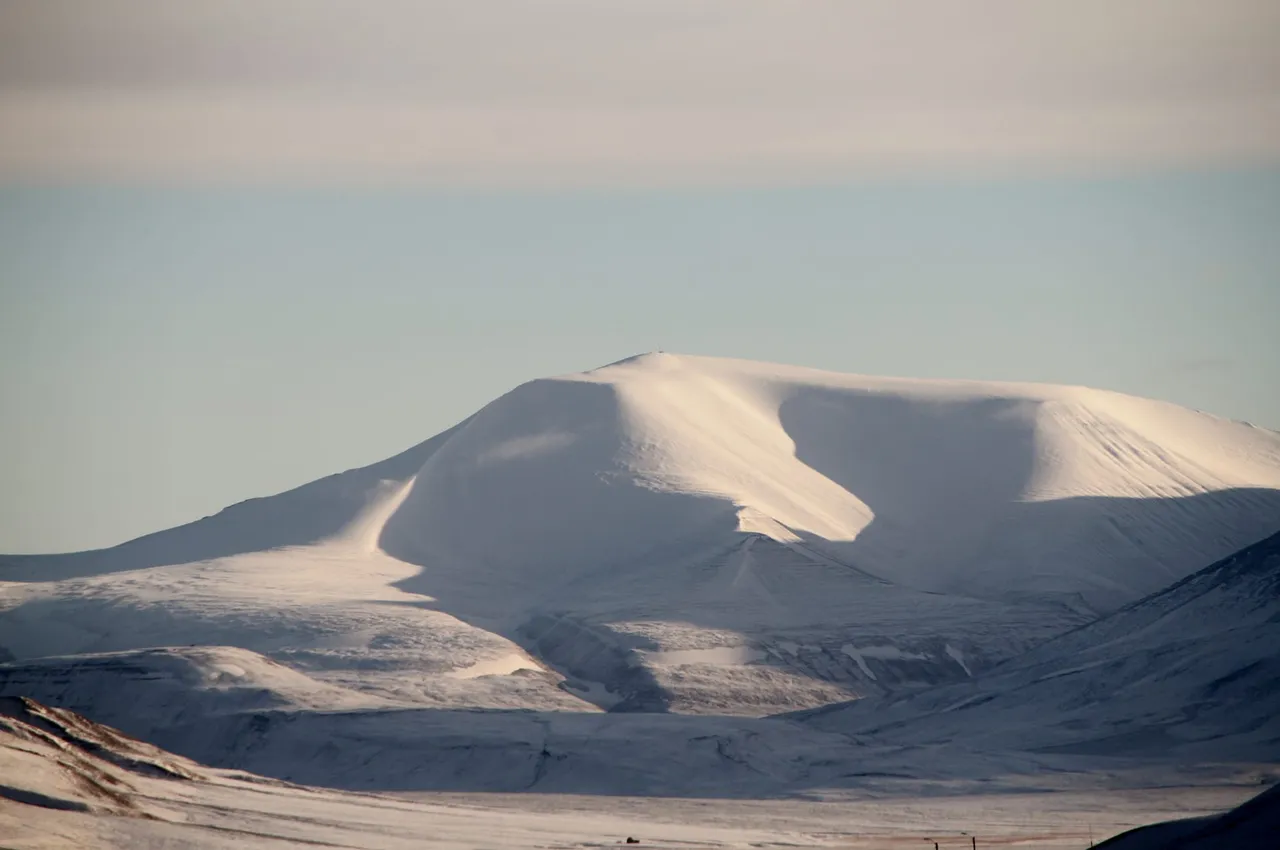
Photo: Bjoertvedt, CC BY-SA 3.0

IOTA
Svalbard has three active IOTA groups:
| Reference | Group | Includes |
|---|---|---|
| EU-026 | Spitsbergen | The main island, including Longyearbyen |
| EU-027 | Bear Island (Bjørnøya) | Bjørnøya |
| EU-063 | Spitsbergen’s coastal islands | Islands such as Hopen and Nordaustlandet |
An operation from Longyearbyen, including from JW5E, counts for EU-026.
SOTA
The SOTA association JW (Svalbard) has 1,422 summits in 12 regions. Most are in Nordvest-Spitsbergen, Sør-Spitsbergen and Midt-Spitsbergen. Several are within about 10 km of Longyearbyen, measured in a straight line:
| Summit | Name | Height | Points |
|---|---|---|---|
| JW/MS-087 | Adventtoppen | 786 m | 6 |
| JW/MS-051 | Hiortfjellet | 926 m | 8 |
| JW/MS-063 | Lars Hiertafjellet | 878 m | 6 |
| JW/MS-007 | Nordenskiöldfjellet | 1,051 m | 10 |
| JW/MS-072 | Louisfjellet | 855 m | 6 |
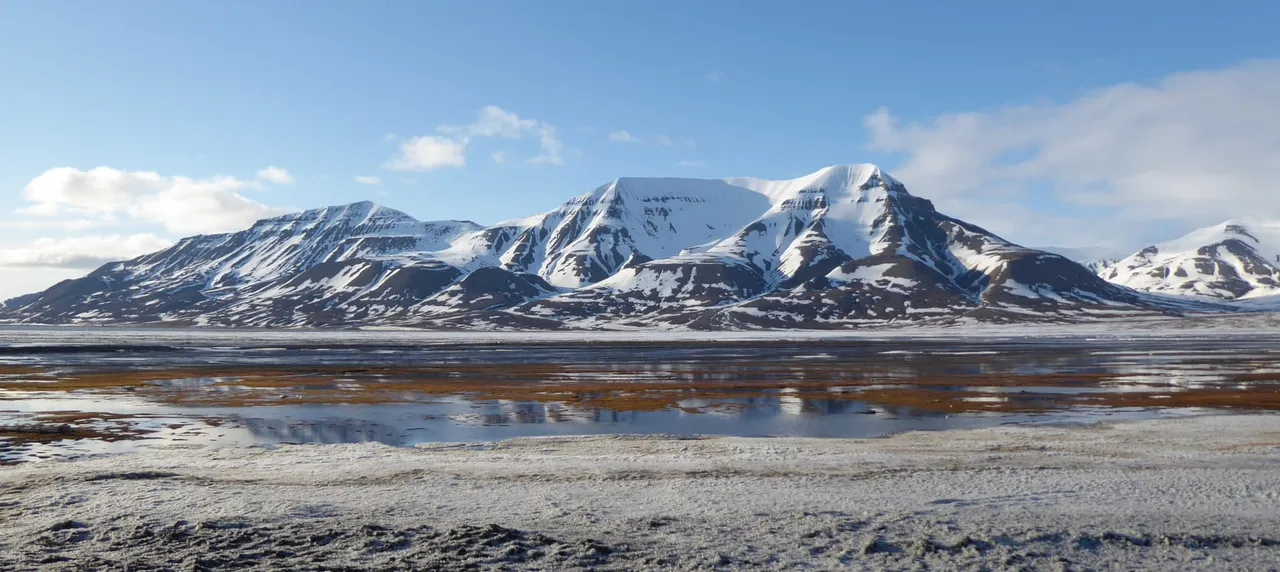
Photo: R. Henrik Nilsson, CC BY 4.0

Every summit is outside the town limits, which changes how you activate it:
- Polar bear protection. You need suitable means of scaring off polar bears, and should carry a rifle, or go with a local guide. Read Polar bear safety before you plan an activation.
- Terrain and weather. Avalanches, glaciers and sudden changes in the weather are real risks on these mountains; see Safety in Svalbard.
- Further afield. For summits beyond the travel area around Longyearbyen, you must apply to the Governor at least four weeks ahead and carry search and rescue insurance.
POTA
Svalbard is part of the POTA program SJ, which POTA lists as “Svalbard and Jan Mayan”. It has 31 references, all national parks and nature reserves: 30 in Svalbard plus the Jan Mayen Nature Reserve. Most still carry older NO- numbers, such as NO-0463 for Forlandet National Park; two use SJ- numbers. Forlandet is by far the most activated, while most Svalbard parks have never been activated at all.
These are protected areas, and the rules are strict:
- Bird sanctuaries are closed to all traffic from 15 May to 15 August, on land and within 300 metres of the shore.
- Moffen Nature Reserve is closed from 15 May to 15 September, including a 300 m zone around the island.
- Kong Karls Land is closed all year, with a 500 m zone off the coast.
The parks are all outside the settlements, so the same polar bear, travel area and insurance rules apply as for SOTA. If you’re travelling on a cruise or a tour, ask the operator before planning an activation ashore.
Planning checklist
- Licence: CEPT licence, or a T/R 61-01 equivalent, printed and with you. Call sign JW/ plus your home call.
- Station: book JW5E well ahead, and bring your own radio and amplifier.
- Accommodation: book it separately; the club station doesn’t include any.
- Outside town: polar bear protection or a guide; for remote areas, the Governor’s application four weeks ahead and insurance.
- Ny-Ålesund: no transmitting in the radio-silent zone without clearance from Kings Bay.
Sources
- https://docdb.cept.org/download/4422
- https://lovdata.no/dokument/SF/forskrift/2026-03-23-465
- https://jw5e.com/
- https://jw5e.com/bookinginfo-2/
- https://jw5e.com/equipment/
- https://www.iota-world.org/islands-on-the-air/iota-groups-islands.html?filter_search=EU-026
- https://www.iota-world.org/islands-on-the-air/iota-groups-islands.html?filter_search=EU-027
- https://www.iota-world.org/islands-on-the-air/iota-groups-islands.html?filter_search=EU-063
- https://api2.sota.org.uk/api/associations/JW
- https://api.pota.app/program/parks/SJ
- https://kingsbay.no/safety-issues-radio-silence/
- https://cruise-handbook.npolar.no/en/svalbard/protected-areas.html
- https://www.sysselmesteren.no/en/travel-in-svalbard/application-and-registration-requirement-for-trips-to-svalbard/
- https://en.visitsvalbard.com/visitor-information/faq
- https://www.toll.no/en/corporate/import/norwegian-customs-in-svalbard